Homeschool curriculum, personalized learning, alternative education
Homeschool curriculum, personalized learning, alternative education
We all want two things in life for ourselves — and especially for our children:
Success and (perhaps more importantly) happiness.
Originally published June 2025
By: Bethany Valentine
But how do we actually get there? What do we need to learn, do, or become to make that a reality?
Before we can move forward, we have to begin by defining our two key terms:
Success
The Oxford dictionary defines success as “the accomplishment of an aim or purpose”. Success is shaped by culture, and the American ideal — often defined by wealth and status — is increasingly influential worldwide.
Populace, a nonprofit think tank, conducted a survey through Luntz Global asking people about their perspectives on how society defines success. Nearly three thousand men and women participated; the most common responses were what you might expect: wealth and status. When asked about their personal definition of success, only 18% agreed with society’s view. 40% of participants shared that they had diverged from this view, and a large majority now said their personal definition of success focused on happiness and achievement. The survey went on to ask participants what kind of person society considered most successful. Respondents said that it was “someone powerful”. However, 91% said that they considered “someone who is purpose-driven” to be most successful.
Happiness
Happiness, and its pursuit, are written into the very foundation of the United States. Listed after “life” and “liberty” in the Declaration of Independence, it has been hotly debated and largely overlooked. The Oxford Dictionary defines happiness simply as “the state of being happy” — Not exactly enlightening. It further explains that happy is “feeling or showing pleasure or contentment.” So happiness is the state of feeling or showing pleasure or contentment.
This modern definition has led some to believe that the Founding Fathers felt that pursuing pleasure was one of the primary rights of all human beings. This is a rather hedonistic view that can quickly deteriorate into all kinds of vice and debauchery. What’s more, it’s not what Thomas Jefferson meant when he was writing the Declaration.
Like most words in the English language (at least those that have been around for some time), the word “happiness” has undergone a transformation over time that can leave it lost in translation. In its original form, happiness simply meant “the state of fitting one’s circumstances”. By the time of the American Revolution, it had changed slightly to mean “the favorable state of fitting one’s circumstances”. In other words, Thomas Jefferson was referring more to personal fulfillment than pleasure. The Founding Fathers believed that everyone had a fundamental right to pursue the circumstances that fit them best, and they believed in it so strongly that they placed it alongside life and liberty in its importance.
In his book Thrive, author Dan Buettner investigated the happiest region on each of the four continents to explore what contributed to their high levels of reported happiness. What he discovered was that thriving was determined by seven major factors in people’s lives:
1. Enough money to cover their basic needs
2. A caring group of healthy friends
3. Working at meaningful jobs
4. Engaging in enriching hobbies
5. Staying in reasonable shape
6. Volunteering
7. Belonging to faith-based communities
The relationship between success and happiness is complex but often follows a clear pattern:
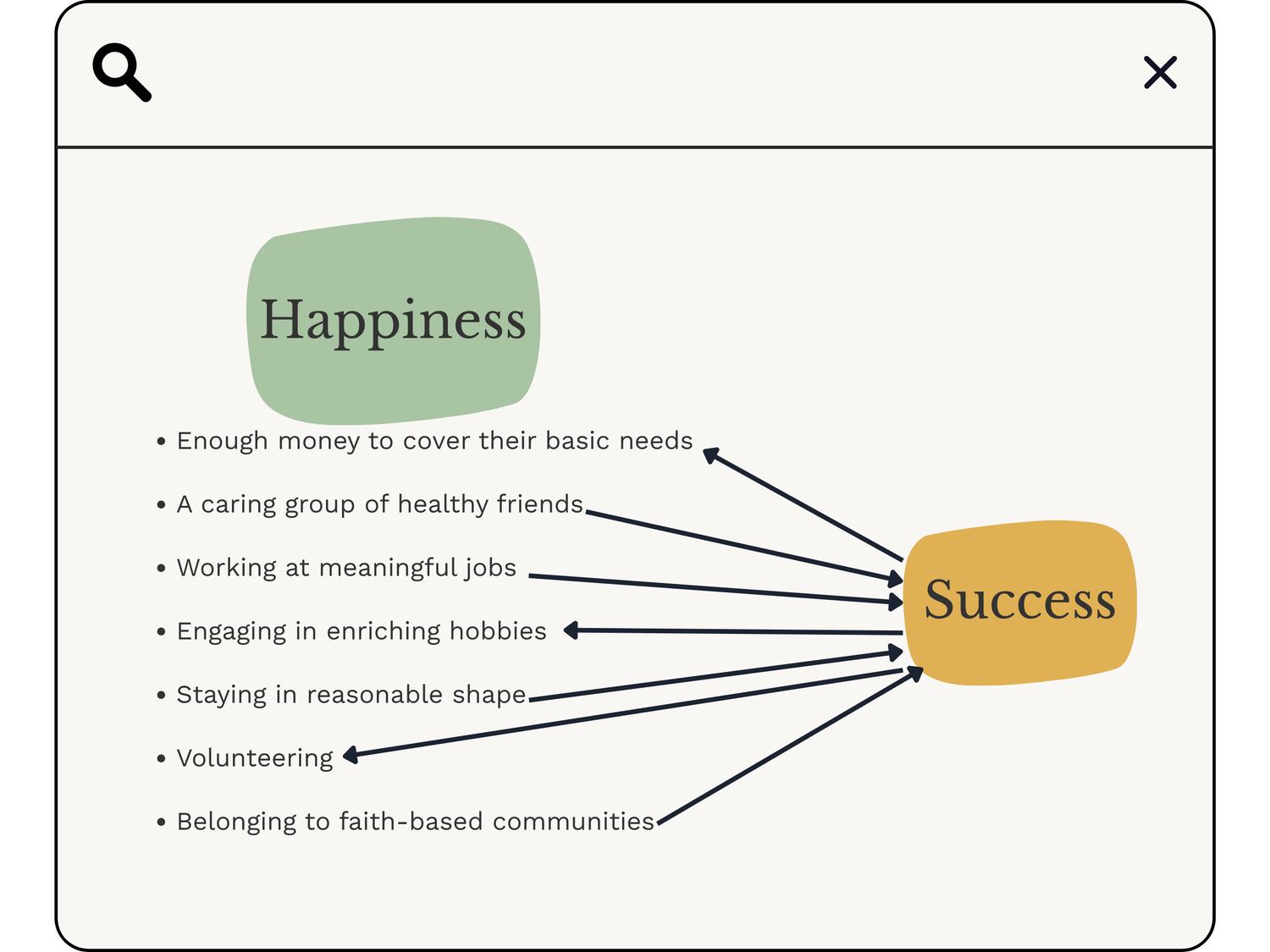
The relationships related to employment are fairly straightforward:
Meaningful work drives success — people perform better when they enjoy what they do.
Being successful at your job generally leads to having enough money to cover your basic needs, which in turn contributes to happiness.
Being successful at your job and having enough money to cover your basic needs can lead to disposable time and income to invest in pursuits like enriching hobbies and volunteering, which further contribute to happiness.
Some of the other relationships can be less clear and require additional consideration:
A caring group of healthy friends and belonging to faith-based communities can contribute to success indirectly through the happiness they provide, but they can also contribute more directly to success by providing connections to job opportunities or other resources.
Staying in shape can contribute to success because maintaining health is vital to being able to participate in meaningful work as well as other beneficial activities.
Story time...
I was one of those kids who did well in school with very little effort. You would think that would make me a strong advocate for the school system as it is, but hear me out.
Yes, I enjoyed school, but while I was good at playing the game, writing the papers, taking the tests, and showing how much I was "learning", it still felt like something was missing. I swung wildly between wishing for MORE in some subjects (like literature and my ONE psychology class) and wondering, "why am I doing this to myself?" (I dropped Calculus 2 senior year because...why?) But like most people, I was told that college was the key to success, so I went there, spent tens of thousands of dollars on a Psychology degree, and ended up finding out that psychology and social work majors are some of the lowest paid college graduates. So much for the path to financial success. For that, you have to go on and get at least one, if not two more degrees (MA & PhD).
But life, and its associated living costs, were calling, so I had to put my high-paying therapy career on hold and get a job. I began working with troubled youth at a therapeutic group home, and while I had always envisioned myself working with military personnel, I found I enjoyed the teens. I enjoyed getting to know them as individuals and learning what made them tick. I found I was successful at using this knowledge to help them discover and work toward goals to improve their lives.
During the next 10 years, I worked in a number of different positions helping teens in and out of the foster system with learning life skills and preparing for adulthood. I also had three children of my own, and when it came time to start educating them, I knew I wanted something a bit different.
My oldest was the guinea pig (sorry, bud). He attended Montessori from 18 months through preschool—but needed more challenge.So for Kindergarten we tried a brand new experimental school (not a great fit) and then a highly rated public school with an International Baccalaureate (IB) program.
Then COVID hit.
There's no need to explain how that threw everyone's educational plans for their children into a spiral. My son started spring break in March and never went back. There was nothing in the way of "standard" education happening. But I didn't want to feel like he was "falling behind". Since I was working at home, I started doing lessons with him in between virtual meetings, and before I knew it, we were homeschooling.
When school started back up virtually in the fall, we initially continued with his enrollment in the public school, but it quickly became clear that it wasn't going to work for us. Not because my son didn't love sitting in front of the computer screen (he did) and not because he couldn't do the work (he was already ahead of the other children in his "gifted and talented" class), but because he didn't know how to work the computer! I struggled to be his on-call IT department while also completing my duties at work. So we withdrew him and decided to permanently continue with our lessons-between-meetings homeschool.
I researched and bought curricula I hoped would be as "rigorous" as I had wished my own education had been, and my son thrived. I felt great about my choices and myself as a homeschool "teacher". And then my second child came of "school" age. He's one of those kids who won't do ANYTHING unless it's his idea. Sitting down for lessons was a struggle. He tried to insist that he had his own way of counting. I became frustrated and burned out trying to get him to conform to the curriculum I was used to using.
I knew there had to be another way, and I started researching and learning about the modern science of education. I had seen the power of choice in motivating my foster teen clients to pursue their goals, but I hadn't considered that the same mindset might be applied to education in general, rather than just life skills. I had heard of unschooling, but it always seemed too devil-may-care for my type-A personality. But as I read about the science of motivation and play, and stories of people who had forged their own paths in both education and careers, I began to feel like there might be something to making education fit the child, rather than the other way around.
Meanwhile, I eased up on trying to force my second son to learn "by the book" and noticed a curious thing: he continued learning. We would have conversations that proved to me, without a doubt, that he was thinking through math concepts and applying them to new situations. What's more, he was extrapolating them into higher-level math skills we had never even covered.
My older son had begun to struggle under the weight of all the things he was "expected" to learn as he "progressed" through his education. We sat down and discussed what he actually wanted to learn and how he wanted to do it. Then I let him do it his way (yes, me! Ms. Type A!) and a miraculous thing happened: he began to thrive again and took on projects and topics I wouldn't have expected.
Needless to say, I was thrilled. But what really sold me is when I realized that I had discovered my OWN personalized education path. I had taken my teaching skill that I had developed through working with my clients and homeschooling my children, combined with my love of psychology and learning, and I had found my passion. Now I wanted to share it with others.
And that’s how I ended up here. It's why I created the CULTIVATE method — a modern, neuroscience-backed alternative to the one-size-fits-all education system. CULTIVATE is not just a homeschool method; it’s a mindset shift rooted in what actually drives human success and happiness.
“Do not go where the path may lead, go instead where there is no path and leave a trail.”
— Ralph Waldo Emerson
Now, back to the burning question where we started: How do we get this life of success and happiness we're hoping for?
The first step is realizing that the one-size-fits-all path we’ve been sold isn’t working. We’re all told from a young age that if we just follow “the path”, then we will find success.
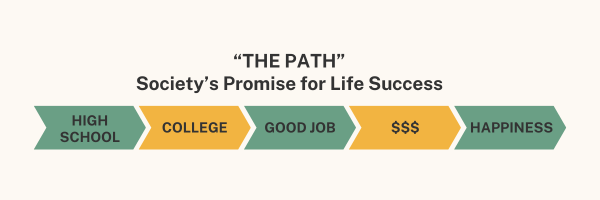
If this really is “the path” to success, then why do so many people who follow it fail to find success and happiness?
Why is the math proficiency of American children so low and getting worse?
Why are teens graduating without basic academic or life skills?
Why are people having to give up their dreams because of student loan debt?
Why are computer engineers facing twice the unemployment rate of art history majors?
And on the flip side — what about the people who have the dream job, the money, the success… but still aren’t happy?
Could it be that “the path” that we’ve been sold isn’t actually right for everyone?
We're stuck with an outdated system
Our current system of standardization (standardized education, standardized career paths, standardized medicine, etc) worked well during a time when everyone needed to be able to do the same things, and the way to success and happiness was more straightforward for a majority of people. This system arose with the advent of the Industrial Revolution, when most people either needed to be able to operate machines or manage people operating machines. These individuals needed to be educated in certain topics and to a certain standard to ensure that their jobs would be done correctly. Thus, the standardized education system was born to prepare people to fill these factory-based jobs.
However, something began to change in the mid-20th century. With the development of the transistor in 1947 and the subsequent development and improvement of computers, the US and the world began shifting from an age of industrialization to an age of information. By 2005, 80% of America’s GDP was coming from service-based industries.
In their “Future of Jobs Report 2023,” the World Economic Forum reported that the top skills employers are now seeking include:
Analytical thinking
Creative thinking
Resilience, flexibility, and agility
Motivation and self-awareness
Curiosity and lifelong learning
Meanwhile, our children are still taught in the same system that values:
Memorization over analysis
Conformity over creativity
Rigidness over flexibility
Compliance over motivation
Performance over curiosity
Our workforce has evolved — but our school system is still stuck in the Industrial Age.
This disconnect is only growing larger and clearer with time. As technology
continues to advance, we are increasingly coming to expect the control and personalization it affords us in all aspects of our lives. Our phones, cars, music, TV, and even medicine are becoming more and more curated and customizable to us as individuals. Meanwhile, our children continue to be subjected to a one-size-fits-all education, based on a fictional “average” child, which ostensibly leads to “the path” through life to success. But what they’re finding is that they are unprepared for the REAL world in a multitude of ways.
“We are educating people out of their creative capacities.”
— Sir Ken Robinson
Succeeding in the modern world
Amid all this, here’s the good news: There is a solution.
And it doesn’t involve fancy curricula, expensive tutors, or working yourself (or your kids) to burnout.
The answer lies in personalized education — a path that aligns learning with a child’s unique strengths and leads to a one-of-a-kind life.
What if, instead of this...
...learning looked like this:
Career paths are no longer linear. Few people graduate, land a job in their field, and stay there for life. Sure, there are some careers where this is more common than others, but for the majority of people, life takes a much more meandering path.
➡️ A person might finish college, get a job in their chosen field, and then find they hate it.
⬇️ Another might find there are no jobs available in their chosen field.
↖️ Someone might go straight to their graduate degree, while someone else doesn't return to school until they've been in their field for 20 years.
🔀 Nowadays, getting a college degree at all is becoming increasingly unnecessary. More and more companies recognize that it's possible to be highly successful without attending college and are waiving degree requirements as long as you can prove you can do the job.
↩️ Young people are beginning to rediscover the trades, which might require any combination of apprenticeship, in-school training, or on-the-job training
🔃 And some people are forging a unique path through different types of job experience, internships, travel, and entrepreneurship.
Today, it’s far more valuable to know how to solve problems, collaborate, and create than to memorize formulas, dates, and theories.
“This is all well and good,” you say, “but how do I put personalized learning into practice for my child?”
The homeschool revolution
Many of us began homeschooling with the desire to remove our children from the drag of our outdated school system, especially when our children are struggling with diagnoses or with just fitting into this one-size-fits-all system. For some of us, we see the opportunity for our child to have more than what schools can offer them. All of us want to give our kids a better shot at the happy and successful life we dream about, and we feel alternative education, like homeschooling, is the best chance we have. And it is a step in the right direction. The problem isn’t in our intentions, it’s in our execution.
When it comes time to actually start “doing” homeschool, it’s common to feel uncertain. There are so many methods, programs, and curricula available that it can be very overwhelming. It feels like we have to pick a label to describe what our homeschool is. Are we classical, Charlotte Mason, project-based, or maybe eclectic? Then comes the really hard part: what will we teach our children and how? If you’ve ever looked through a homeschool curriculum catalog/website or visited a social media page where people are sharing their favorite programs, you’ll know that the sheer number of options is astounding. Faced with a complicated—but critical—decision, it’s easy to default to what feels familiar. Soon we find ourselves with a pile of math books, reading lists, and history and science texts that look alarmingly like a classroom.
Suddenly… we’re just doing school at home.
What happened to that dream of something better?
It got swallowed up in decision fatigue, peer pressure, parental anxieties, and our own educational programming. It’s common at this point to experience some of the same struggles at home that your child was experiencing at school. This often contributes to feelings of burnout amongst homeschooling parents.
So what can we do?
Answer? DO LESS
The truth about children
First, let's get a few things straight:
Children are natural learners
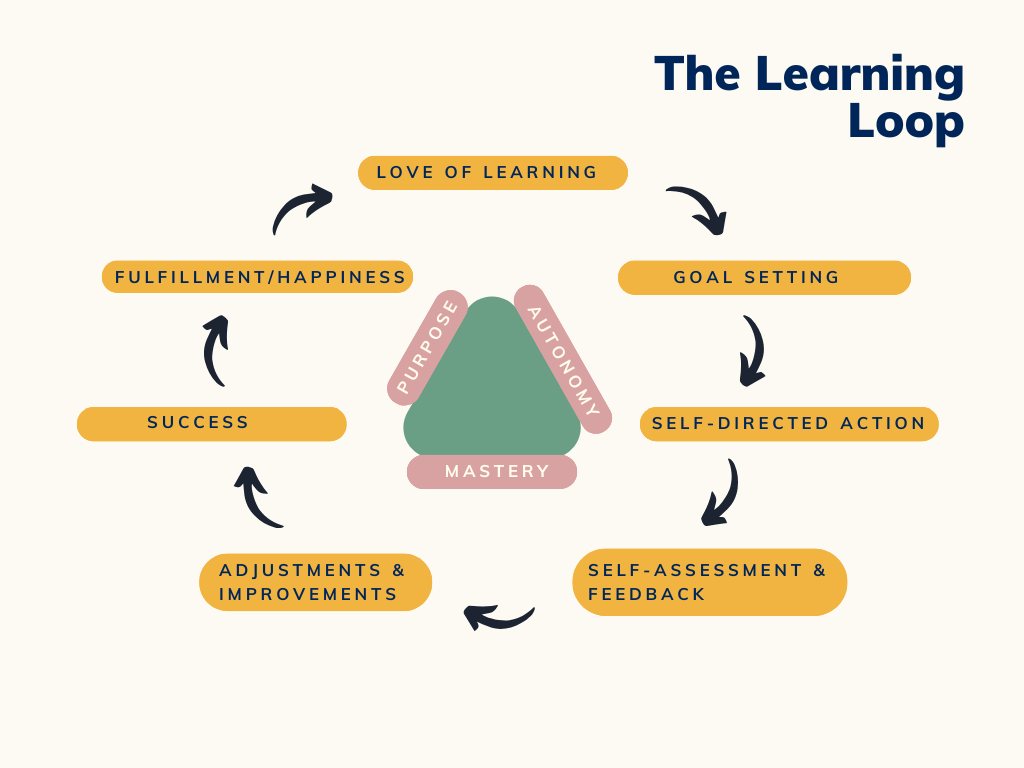
Children act almost completely because of curiosity, a desire to master and feel competent, and pride in doing good work (This is the science behind motivation: autonomy, mastery, & purpose)
Children are more competent than adults realize or give them credit for
Children live up (or down) to our expectations of them (as long as those expectations are achievable)
“It’s not how smart you are. It’s how you are smart.”
— Howard Gardner
The truth about learning
1. True learning is non-linear
You’ve passed plenty of tests you don’t remember — but the skills you use often? Those stick. That’s how real learning works. That’s because retrieval and repetition = learning. Learning something once and never using it again isn’t a recipe for mastery. To truly LEARN something, the best way is to study it, practice recalling it, and then move on to something else for a while before coming back and practicing it again. It’s a loop.
Another loop in the learning system is the one used by scientists (and very young children): question, hypothesize, experiment/test, observe, conclude, retest, and so on. Trying to solve a problem on your own before seeking out or being taught the answer results in better learning, whether or not your initial guess/hypothesis ends up being correct.
2. True learning is self-directed
Want your child to stay motivated and retain more? Let them pursue what genuinely interests them. Autonomy (or control, or self-determination) is the first ingredient in motivation. This is because self-selected activities (ones that are chosen due to personal interest rather than necessity) are much more likely to be experienced as play, rather than work. If people don’t enjoy what they’re doing, it’s unlikely they will be able to rise to the highest levels of proficiency in that activity or that they will stick with it for very long.
3. True learning is natural
If you have ever seen a baby or toddler at play, then you will know that it is serious business for them. They can concentrate for significant lengths of time on a simple action such as pulling something out and putting it back in. Humans are wired for learning beginning at birth, and it is only “schooling” that inhibits the drive for curiosity, creativity, and exploration.
4. True learning is connected
All learning is interrelated. If you think about your own job, or other activities that you do regularly, rarely does it consist ONLY of science or ONLY of reading. However, artificially separating education into subjects is a hallmark of the modern education system. Elaboration is a learning process by which new information is given meaning when it is connected to things that you already know. Putting knowledge into a larger context in this way makes learning more effective because it allows our minds to construct stories and models that are later used for recalling that information. When you were a child in school, did you ever find yourself wondering why something you were learning really mattered? Understanding the connections between topics is key for information to matter and be remembered.
5. True learning honors the individual
Within the science of individuality, there is a concept known as “jagged profiles”. This refers to the uneven distribution of skills and knowledge across different areas within an individual. It highlights that a person might excel in some areas while struggling in others, rather than exhibiting a uniform level of proficiency. This concept emphasizes the individuality of learners and the importance of recognizing their unique strengths and weaknesses. It also demonstrates that everyone has talents. Weaknesses in one context may be strengths in another. It’s a matter of finding the right set of circumstances for each individual to thrive.
Real learning is not just about amassing knowledge. It’s a journey of discovery as an individual explores their interests, follows their curiosity, and uncovers their strengths, weaknesses, likes, dislikes, and everything that makes them unique. Real learning stems from the understanding that there is no such thing as an “average” person. Therefore, anything designed for the “average” is actually designed for no one. It doesn’t just say “I want to help others”. It drills down into the why and how of that desire to create a very specific path for the unique individual. This sort of personalization leads not only to a customized education plan but also to a one-of-a-kind career path where a person can find both success and fulfillment by being authentically themselves.
“Education is not the filling of a pail, but the lighting of a fire.” — William Butler Yeats
We don't need to "educate" our children, we need to CULTIVATE learning
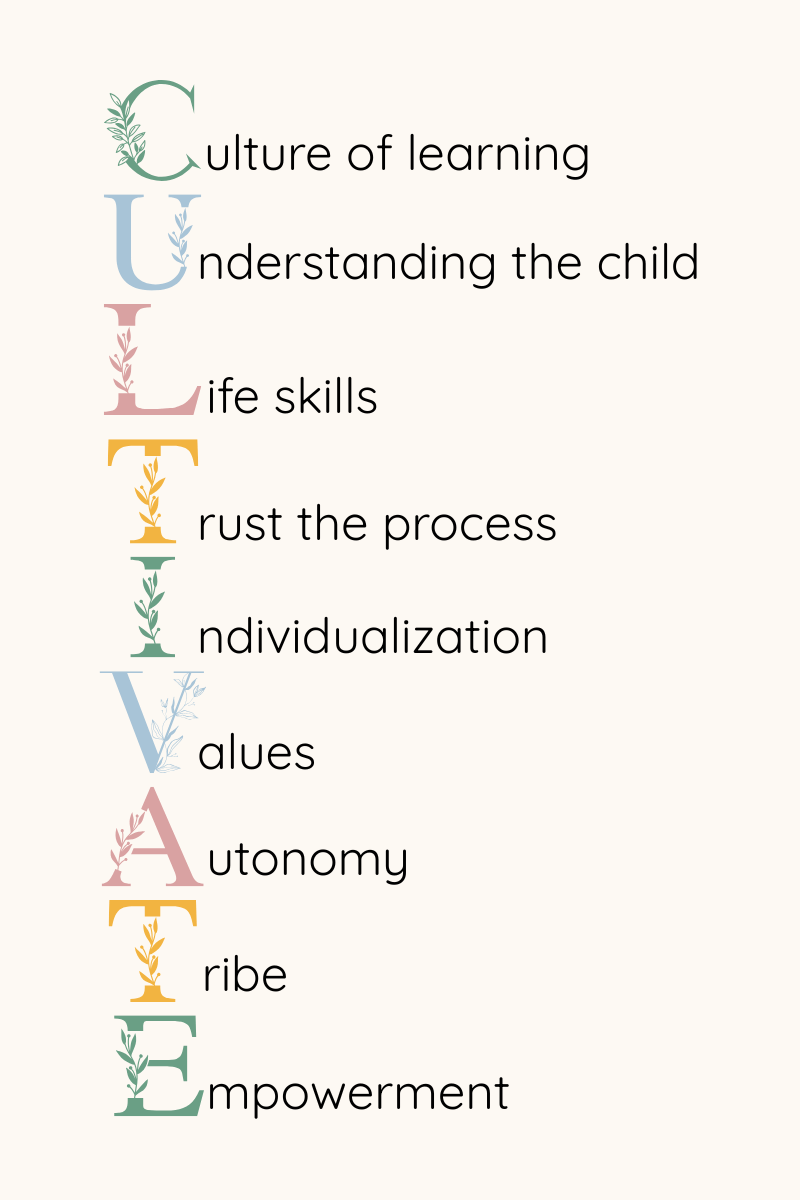
🌱 What Is the CULTIVATE Method?
The CULTIVATE method is grounded in eight principles that reflect how humans naturally learn and thrive. Each letter stands for a key aspect of a personalized, empowering education.
C – Culture of learning: Make learning a part of your family's life and rhythms.
U – Understanding the child: Knowing your individual child is key to creating an education plan that fits their unique needs and interests.
L – Life Skills: Learning to learn should be the focus, everything else can come with time.
T – Trust the process: Following a different path can be scary, trust your child.
I – Individualization: Honor each child’s jagged profile and personal pace.
V – Values: Education is not neutral, we are teaching the next generation how to make the world a better place.
A – Autonomy: True learning must be self-directed in order for it to be motivating and impactful.
T – Tribe: Family and community connections are foundational to learning.
E – Empowerment: Self-directed learning increases feelings of self-efficacy and satisfaction.
A CULTIVATE-d education sets kids up to live their best life by focusing on what we know about what makes people happy and successful in the real-world. Our kids don’t need to know more, they need to learn to think differently.
Ask yourself:
What do I want my child to be able to do in 10 years?
What qualities do I want them to carry into adulthood?
When I worry about them “falling behind,” what am I afraid of?
Am I building their ability to think for themselves, or just their ability to jump through someone else’s hoops?
This is not a trap—it’s a pivot point. You get to decide what success looks like. And you don’t have to play by rules that never worked for your child in the first place.
Learning is not a linear process—it loops. It spirals. It evolves. It works for a 7-year-old obsessed with insects and a 17-year-old questioning climate policy. It’s what builds a learner who can adapt, not just recall.
Instead of chasing mastery, it nurtures agency.
Instead of measuring retention, it builds resilience.
Instead of prioritizing content, it develops capacity.
🧭 You Don’t Need a Curriculum. You Need a Compass.
Modern education told us to follow "the path": check the boxes, stay the course, trust the system. But "the path" was never made for your child. It was made for the “average student” — who doesn’t exist.
What your child needs isn’t a rigid route. They need room to grow, space to think, and the support to become who they are, not who a system expected them to be.
“When we are no longer able to change a situation, we are challenged to change ourselves.”
— Viktor Frankl
Learning garden
When talking about educating children, it’s common to use the metaphor of a garden. People liken education to planting a seed. You can prepare the soil, give it the right water, light, and nutrients, but you can’t actually do the growing yourself. Growth happens from within the seed and the plant itself.
Everyone knows that plants don't NEED a gardener at all. They grow in the wild without any help all the time. Am I saying that children will learn all on their own without any intervention? Absolutely. Am I suggesting that you should abandon your children to the wild or ignore their needs because they can fend for themselves? Absolutely NOT. While it’s true that plants grow in the wild, being tended to by humans can make them more than they ever would be if left to their own devices. Most of the fruits and vegetables we now see regularly at the grocery store were bred by humans to be the way that they are.
A good gardener knows when to provide structure. Some plants grow well in the structure of a pot, some need support, such as tomato cages or climbing trellises, and some do just fine standing on their own.
A good gardener knows that a little adversity is key to having healthy plants. Plants need stress from sources such as periods of lower water so they learn to dig deeper roots, or stress from wind to help them develop a stronger support system. (Scientists grew trees in Biosphere 2 where there was no wind, and when they got big enough, they simply fell over.)
A good gardener knows how to replicate the conditions of the wild when it’s beneficial. Plants in the wild do not grow in neat rows with other plants of their kind. They grow in groups (sometimes known as “guilds” or “companion planting” in the gardening world) in which the different types of plants support those growing around them by providing nutrients or keeping away pests.
A good gardener doesn’t expect more than a plant can give. Expectations are rooted in reality — not fantasy. There are no rules that a tomato plant must produce before it is ready, bear more fruit than the plant can hold up, or produce strawberries when that is clearly not its purpose.
And a good gardener knows when to provide outside help. If there hasn’t been enough rain, a gardener doesn’t let their plants wither, they bring in water to keep their garden growing. When weeds are interfering with the garden’s growth, the gardener removes them. And the gardener even supplies some pruning services when necessary and beneficial for a plant’s health.
This kind of nurturing and supportive environment, free from pressure or excessive expectations and curated to each individual, is exactly right for plants, and it’s exactly right for children. Don’t let what you see in your neighbor’s garden, or especially in the large-scale factory farms (I.e., Schools), control how you educate your own child. They are unique, you are unique, and your family is unique.
The freedom to personalize education and life is one of the great gifts of the modern world — and one of the surest ways to help your kids (and yourself) achieve the joyful, meaningful life you dream of.
“Children learn from anything and everything they see. They learn wherever they are, not just in special learning places.”
— John Holt
🌟 Ready to CULTIVATE a Better Way?
If you're feeling the pull toward a more authentic, empowered path for your child, you're not alone. Thousands of families are stepping off the conveyor belt and into the garden.
💻 Join me for the free Back to Homeschool Webinar on July 19, 2025 at 1pm MST — where I’ll walk you through how to implement the CULTIVATE method in your home.
🎯 You’ll learn how to:
Create a custom learning path that engages your child
Tap into their unique “learning sparks”
Build a plan rooted in purpose, not pressure
Join the CULTIVATE Revolution
Get started today by joining our FREE Back-to-Homeschool Webinar.
Next Webinar TBD
As a thank-you for signing up, we'll send you some free planning templates to help you get started.
Can't wait to see you there!
On this website we talk about:
🌱 The CULTIVATE Method to giving your child the education they need to succeed in the real world.
🧪 The Science of Learning & Education that's missing from the school system.
🚫 Deschooling: disconnecting ourselves from the school-shaped models we inherited so we can radically re-think education for our kids.
🛠 Tools & Models to help you create a more meaningful education experience for your child (and enjoy it more)
Join our newsletter for education tips and tricks

Built with systeme.io | Privacy policy | Terms and conditions
Join our FREE Back-to-Homeschool Webinar
🍎 Ready to Reimagine the School Year?
Whether you're brand new or simply craving a better rhythm, you'll walk away with clarity, tools, and fresh inspiration to choose a personalize, child-centered approach that actually fits your family.
As a thank you for signing up, we'll send you some free planning resources RIGHT NOW
(Can't make the date? Don't worry, we'll send you a replay that you can watch in your own time!)